
Dressmaker Customers: The Named Roster and How to Read a Request
The ten Dressmaker customers with full story arcs, how a spoken request becomes a tag list, and how major commissions and re-makes actually work.

Dressmaker has two kinds of work. A standard commission is one dress, delivered once. A major commission is a step in one customer’s story, and finishing all of them completes that character’s arc. Ten customers have an arc confirmed by the game itself. Their names are Vivian, Edith, Adora, Alice, Prudence, Dorothy, Rose, Priya, Marie and Fiona. Each of those ten has an achievement attached to it.
That list is the only customer roster with an official source. The developers have never published a full cast list, and no review counts them. Anything beyond these ten names is a player observation, and this page marks it as such.
What each named customer wants
This table uses only what an official source states. The “arc confirmed” column comes from the achievement set, and the flavour text comes from the store page, the trailers and recorded playthrough dialogue.
| Customer | Where the name is confirmed | What is known about the request |
|---|---|---|
| Rose | Achievement “A Rose By Any Other Name” | The town librarian. Her opening request is a work dress that is simple and elegant, and she is a common first customer. |
| Prudence | Achievement “Prudence and Prejudice” | Wants to stand out at a funeral and calls herself a future duchess. Her brief bans black outright. |
| Priya | Achievement “Drawn to Hue” | Wants to look intimidating at the same funeral, and asks for formal, gothic and professional. |
| Vivian | Achievement “Good Girl Gone Vlad” | Arc confirmed. No published brief. |
| Edith | Achievement “Swan Song” | Arc confirmed. No published brief. |
| Adora | Achievement “Go Off, Queen!” | Arc confirmed. No published brief. |
| Alice | Achievement “Caw Evermore” | Arc confirmed. No published brief. |
| Dorothy | Achievement “Snitches Get Stitches” | Arc confirmed. No published brief. |
| Marie | Achievement “G.O.A.T.” | Arc confirmed. No published brief. |
| Fiona | Achievement “Reap what You Sew” | Arc confirmed. No published brief. |
The remaining townsfolk are unnamed in every official source consulted. Assume there are more than ten, and do not assume the extra ones have arcs.
A spoken request is really a tag list
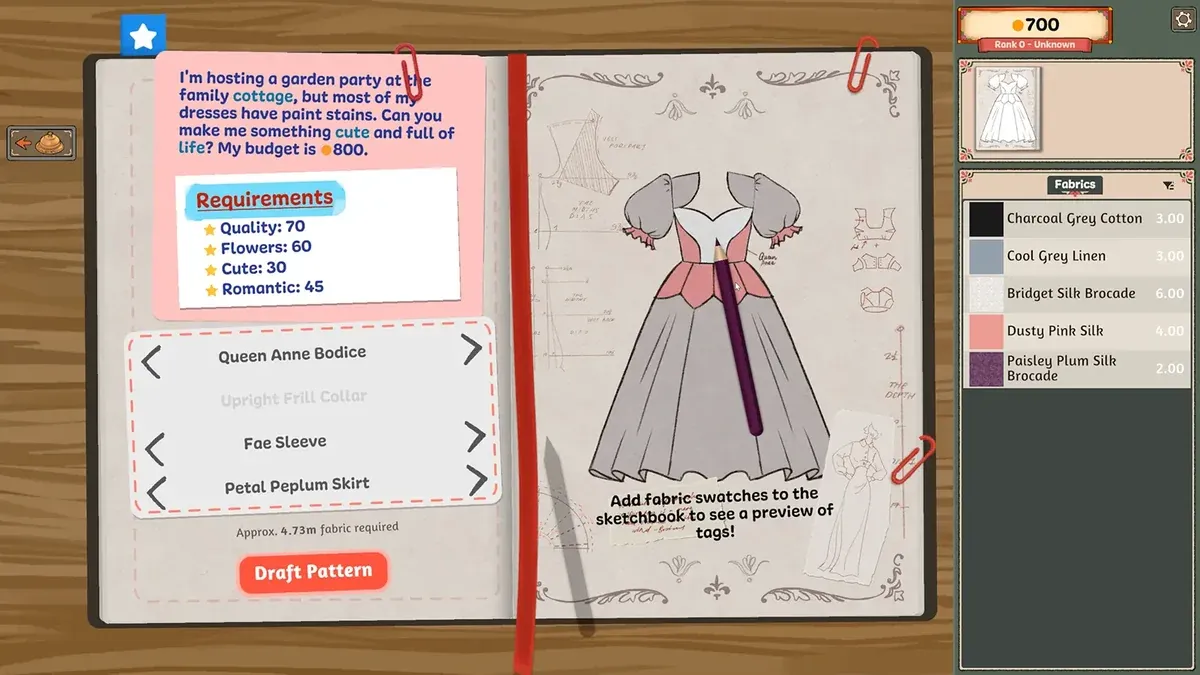
Customers talk like people and the game translates for them. When a customer describes a dress, a panel appears with weighted tags and, in some cases, a budget.
Recorded examples from the finished build:
- Rose, work dress: quality 60 / professional 40
- Prudence, funeral dress: quality 75 / elegant 65 / glamour 40, avoid black, budget 300
- Priya, funeral dress: formal / gothic / professional
You then filter the Emporium by the same words. Tags appear on every fabric and every accessory, and you can filter on more than one at a time.
Two warnings worth keeping in mind, both from the game itself. The interface says tags are only an estimate and that the fabric you actually use affects the final result. And several tags bar you from something rather than asking for it, like Prudence’s ban on black.
Matching the brief beats spending more gold
Expensive fabric does not buy a good reaction. In one recorded session the dressmaker made Prudence a costly charcoal dress. It was rejected twice. The rejection text complained it was not glamorous enough, and it mentioned the colour. The customer’s panel had asked for elegance and glamour, and her brief had banned black. Charcoal is not black in everyday English, but the game’s tags do not see it that way.
The lesson is mechanical, not moral. Read the top two or three tags, pick the silhouette and fabric that carry those words, and treat every other consideration as secondary.
Major commissions are the story, and they come from the same customers
Finishing all of a character’s major commissions is worth an achievement, which means the customer roster and the achievement list are the same ten names. That also tells you something useful about pacing: the story is delivered through commissions rather than through separate cutscenes, so a character’s arc advances when you deliver a dress.
A reviewer described the effect well. Customers talk about each other, and mention the dresses you made for their friends, which makes the town feel connected rather than like a queue of briefs.
What happens when a customer says no
Rejections are recoverable. A customer who dislikes the dress offers an alter option, and you can also rebuild the garment from the sketch stage. One recorded session used both routes: two alters on the same commission, then a full rebuild.
The practical cost is the fabric. Altering around an existing dress reuses what you already bought. Starting over spends again, which is why the pattern cutting page puts so much weight on buying a little more fabric than the estimate.
Story material sits below this line
The next paragraph describes plot beats visible in recorded dialogue, including a rivalry between two customers and the event that brings several of them to you at once. Skip it if you want the story fresh.
Prudence and Priya are both dressing for the same funeral, which belongs to a duke’s uncle. Prudence is openly competing for the duke’s attention. Priya is trying to scare off that same competition. Later customers reference earlier dresses, and at least one asks after another customer by describing her hat.
Related pages
Every unlock condition for the ten character achievements is listed with its current completion rate on the achievements page. The making half of a commission is on the beginner guide.