
Dressmaker Beginner Guide: Every Step of One Commission
The eight stations a Dressmaker commission moves through, in order, plus the three settings and four mistakes that decide whether your first dresses go well.
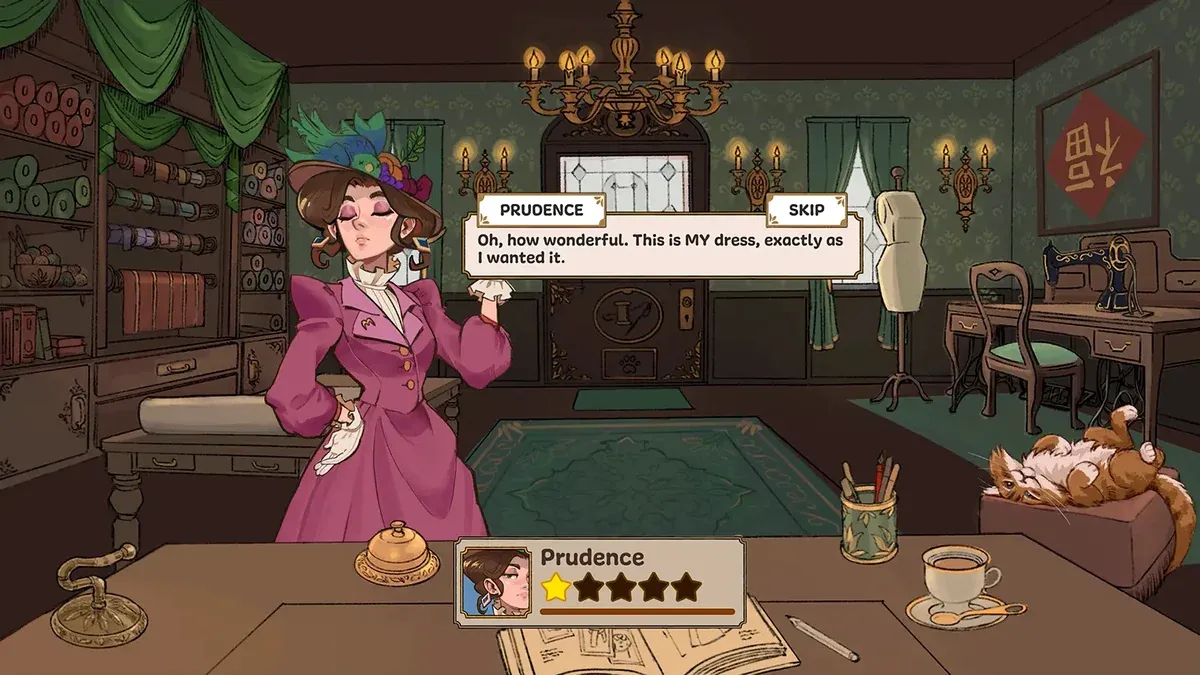
A Dressmaker commission always runs in the same order. Meet the customer. Measure them and set the mannequin to those numbers. Sketch the dress. Buy fabric and trims. Lay out and cut the pattern. Pin and sew the pieces. Add accessories. Then deliver. Nothing in that chain is timed, and the bobbin never runs out. The parts that decide your result are reading the customer’s tags before you spend money, and aligning the grain line while you cut.
That order comes from two independent first-look playthroughs recorded on the finished build, and it matches the loop the official store page and the official release-date trailer describe. Those videos are also the only reason this page can talk about what the interface actually asks you to do. This wiki does not own the game and has no capture of its own.
The eight stations, in the order the game asks for them
| Step | What you actually do | What the game shows you |
|---|---|---|
| 1. Take the commission | Read the customer’s request and accept or decline | The occasion, the taste words and a gold offer |
| 2. Measure the client | Drag the tape onto the customer for bust, waist and hip | Three numbers, then “All measurements recorded” |
| 3. Set the mannequin | Move each dial until it matches the three numbers | A mannequin accuracy percentage; aim for 100% |
| 4. Sketch the dress | Use the arrows to change bodice, collar, sleeve and skirt | A tag readout such as “Quality 60 / Professional 40” |
| 5. Buy fabric and trims | Filter the Emporium by tag, then buy by the metre | Price per metre and how many metres the pattern needs |
| 6. Lay out and cut | Drag each pattern piece onto the fabric, line up the grain line, cut | “Align the grain line horizontally will result in a higher quality garment” |
| 7. Pin and sew | Place pieces on the mannequin, then sew along every seam | A live accuracy readout per seam and the space bar prompt |
| 8. Decorate and deliver | Add buttons, bows and lace, take a photo, hand the dress over | A star rating and the customer’s reaction |
A real example from a recorded first look: the librarian Rose asks for a work dress that is “simple and elegant”, offers 200 gold, and her tag panel reads quality 60 / professional 40. The dressmaker measures her at 86.3 bust, 68.7 waist and 95.8 hip. The pattern is drafted, linen is bought, roughly a dozen panels are cut and sewn, and three buttons go on. Rose is satisfied on the first attempt.
Three settings decide how painful the sewing is
The sewing stage is the one place players consistently complain about, and the game already ships the three fixes.
- Sewing assist lives in the settings menu. With it on, holding the sew key moves the fabric for you and steadies the line. It does not make you perfect — a creator who tested it still went off the seam and said so — so think of it as stabilisers, not autopilot.
- Sewing machine speed is adjustable during sewing. On keyboard it is W and S, and the same creator lowered it for every curve. Slow for corners, faster for long straight seams.
- No timer at all. One reviewer with a dexterity condition wrote that she was nervous about the sewing until she found the assist and realised the game never rushes her.
Read the tags before you spend a single coin
The customer’s words become numbers. A funeral dress came back as quality 75 / elegant 65 / glamour 40 / avoid black; a request to look intimidating at the same funeral came back as formal / gothic / professional. You then filter the Emporium by those same tags.
The interface warns that tags are only an estimate and that the fabric you actually use decides the result. Treat the tags as the shopping list, not the score.
Two mistakes cost real money in the recordings. One creator bought fabric before checking the tag panel and could not afford a second attempt, then restarted the dress twice. The other bought five metres of an unnecessary fabric “just to be safe” and spent most of her starting budget.
Four things new players get wrong
- Buying fabric first. The tag panel is free and appears before you spend anything. Read it, then shop.
- Zooming the mannequin. Multiple players report the camera only rotates when they expect it to zoom. A Steam discussion thread titled “Can’t zoom in” and a Steam review both describe the same thing. Drag first, then try the wheel.
- Ignoring the grain line while cutting. The cutting screen tells you the grain line decides quality. An experienced creator repeated on camera that sewing against the grain makes the drape go wrong.
- Skipping the pinning step. Pieces go onto the mannequin before they are sewn. This is also your last chance to swap one panel into a different fabric, and you can pull a sewn panel off and re-cut it instead of restarting the whole dress.
How long this loop needs to last
The developers put the story at roughly 35 hours of commissions, not counting dresses you make and sell on your own. One creator’s first commission took about ten minutes, including the walkthrough. The second, for a far fussier customer, took three attempts and roughly an hour.
The scale is why the early habits matter. There are over 150 dress pieces, over 450 fabrics and over 350 accessories, so a routine you build in the first hour is a routine you repeat several hundred times.
Where each question goes next
Cutting decisions, quality scoring and the red outline on a cut piece belong to the pattern cutting guide. The sewing stage itself, including the argument about whether it should be skippable, belongs to the sewing guide. Who the customers are and how their stories progress belongs to the customer roster.